
From biological sequences to scientific discovery
Introducing the artificial intelligence models that will drive scientific discovery in the future

AI systems are becoming much better at scientific reasoning. They can answer difficult technical questions, write code, summarize papers, use tools, and combine information across domains. In some benchmark settings, their performance now looks close to, or above, expert human performance.
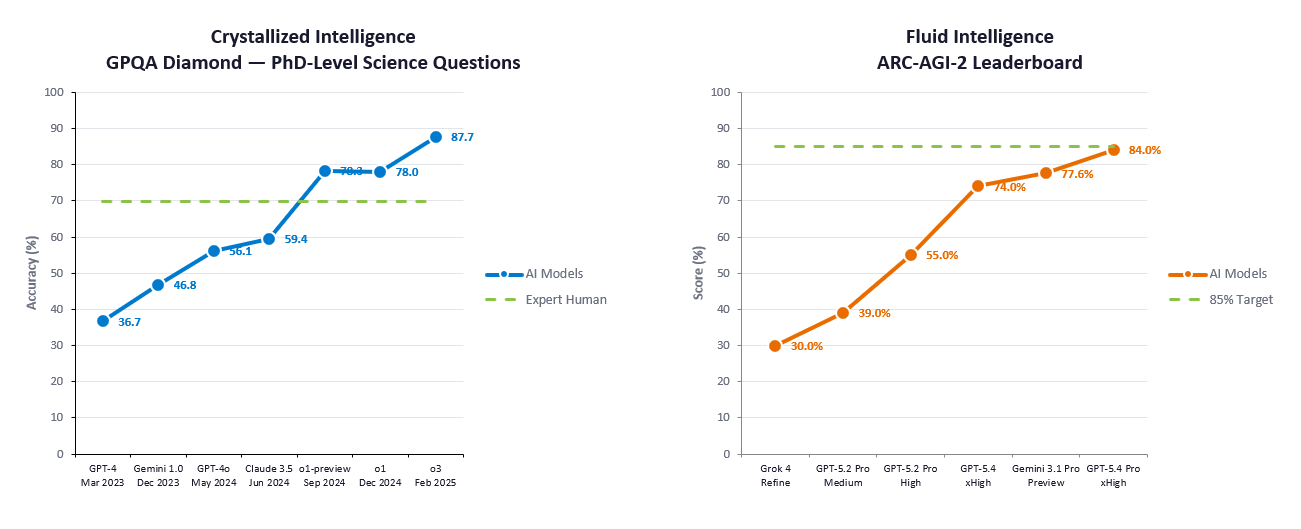
This creates an obvious question for biology: if AI can reason so well, where are the discoveries?
In other words, if AI is so smart, why can’t I just do this:
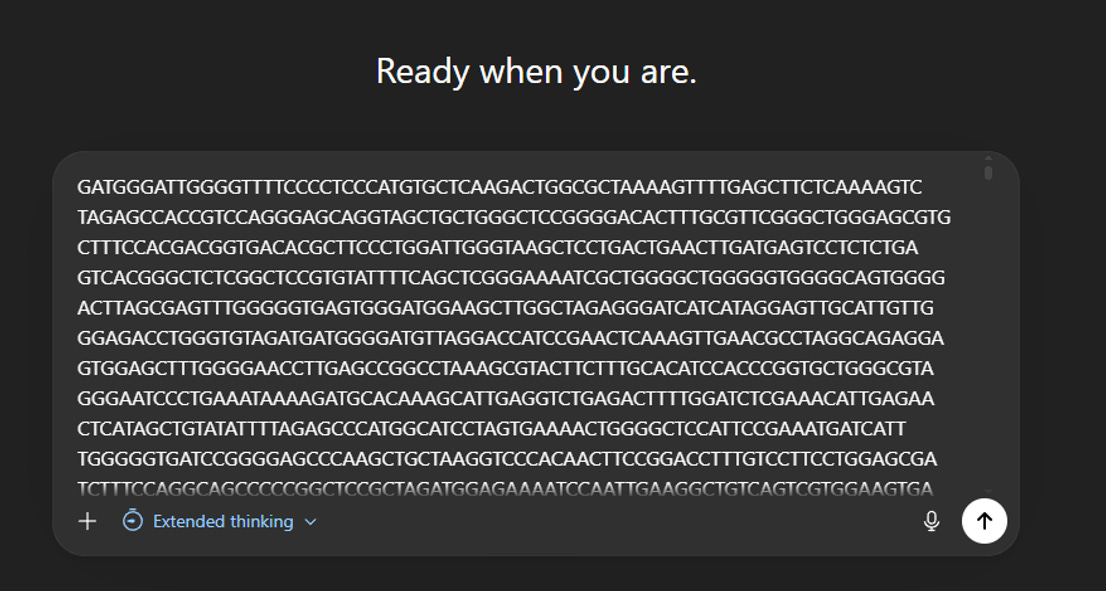
And get meaningful answers to solve new scientific problems.
The answer is not that biology has been ignored by AI, but quite the opposite. Foundation models are now being trained on genomes, proteins, single-cell data, multimodal biological datasets, and the scientific literature itself. Models can classify DNA sequences, predict protein properties, annotate cells, prioritize genes, search papers, write analysis code, and generate biological hypotheses.
Still, a gap remains between prediction and discovery. A model can predict that a genomic region looks regulatory, that a protein mutation may matter, or that a gene appears in the literature around a disease. But those outputs are not automatically scientific findings and they need to be connected to mechanism, disease context, experimental evidence, and eventually to something that can be tested.
The central issue is that biology does not have one language. It has several. We are used to ask questions to language models like chatgpt that answers is in the same language, but some questions can’t be stated in human language.
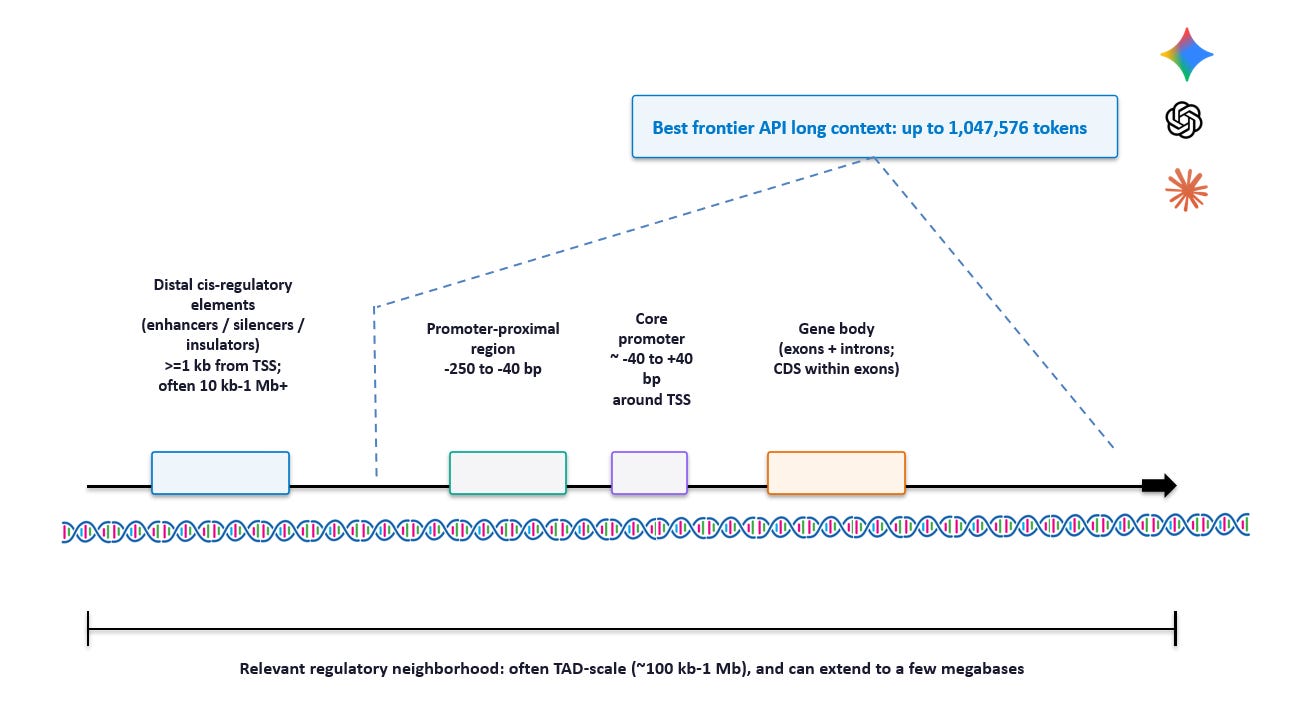
To take the example from the last figure, if we would just naively copy-paste nucleotide sequences to chatgpt, we would miss a lot of context for a gene, simply because the model does not have the capacity to look at the gene’s neighbourhood:
DNA has a language of nucleotides. Proteins have a language of amino acids. Cells have patterns of gene expression that can be treated, imperfectly but usefully, as a kind of biological sentence. Scientific papers and databases have human language.
Foundation models are becoming useful because they can operate on these different languages. The hard part is understanding what each level can and cannot tell us.
Human language and biological language
A human sentence is more than a string of words. If we read “It is a beautiful sunny day in Boston,” we understand syntax, meaning, location, weather, sentiment, and background knowledge. We know that Boston is a city, that sunny weather is usually positive in this context, and that the sentence describes a situation. This is why it’s quite impressive that a model, like a Large Language Model can implicitly learn all these features by just doing next token prediction.
DNA and protein sequences also look like strings, but their meaning comes from biological context. A DNA motif can matter because it affects regulation. A regulatory element can matter because it changes gene expression. A protein sequence can matter because it folds into a structure. A structure can matter because it changes binding, stability, or function. A gene expression pattern can matter because it reflects a cell state or a disease process.
The analogy between biology and language is useful, as long as it is not taken literally. DNA is not English, a gene is not a word in the normal linguistic sense, and a cell is not simply a sentence. But the analogy helps clarify what foundation models are trying to do. They learn statistical structure from large biological corpora, then reuse that structure for downstream tasks.
The question is what kind of structure they learn, and whether that structure is enough to support interpretation.
Level 1: nucleotide sequence models
The first level is DNA and RNA sequence. These models operate directly on strings of A, T, G, and C. They are trained on large collections of genomic sequence and then adapted to tasks such as promoter prediction, enhancer prediction, variant effect prediction, sequence classification, clustering, anomaly detection, or sequence generation.
Models such as DNABERT2, HyenaDNA, and Evo 2 represent this direction. DNABERT2 was designed for easier installation and fine-tuning on DNA sequence tasks. HyenaDNA focused on long-range genomic modeling at single-nucleotide resolution. Evo 2 extends this idea further by training on trillions of DNA bases and handling very long sequences.
The reason long context matters is that genome function is not always local. A promoter-proximal region may sit close to a transcription start site, but enhancers, silencers, insulators, and other distal regulatory elements can be far away. A relevant regulatory neighborhood may span tens of thousands, hundreds of thousands, or even millions of bases.
This is a major difference from ordinary text. In human language, nearby words often matter most. In genomes, the important element may not be nearby in the linear sequence, and the three-dimensional organization of the genome can matter as much as the local letters.
Nucleotide models can therefore provide powerful representations of sequence, but they usually do not produce a complete biological explanation. They may tell us that a region looks functional or that a variant may have an effect. The next question is what that effect means in a specific biological system.
Level 2: amino acid sequence models
The second level is protein sequence. Instead of four nucleotides, protein models operate on around twenty amino acids. This level is closely connected to function because protein sequence influences structure, and structure influences biological activity.
A protein is written as a one-dimensional sequence, but it acts as a three-dimensional object. Its fold determines binding surfaces, stability, enzymatic activity, interaction partners, and sometimes disease relevance. This makes protein language models useful for tasks such as protein classification, structure-related prediction, mutation effect estimation, functional annotation, and de novo protein design.
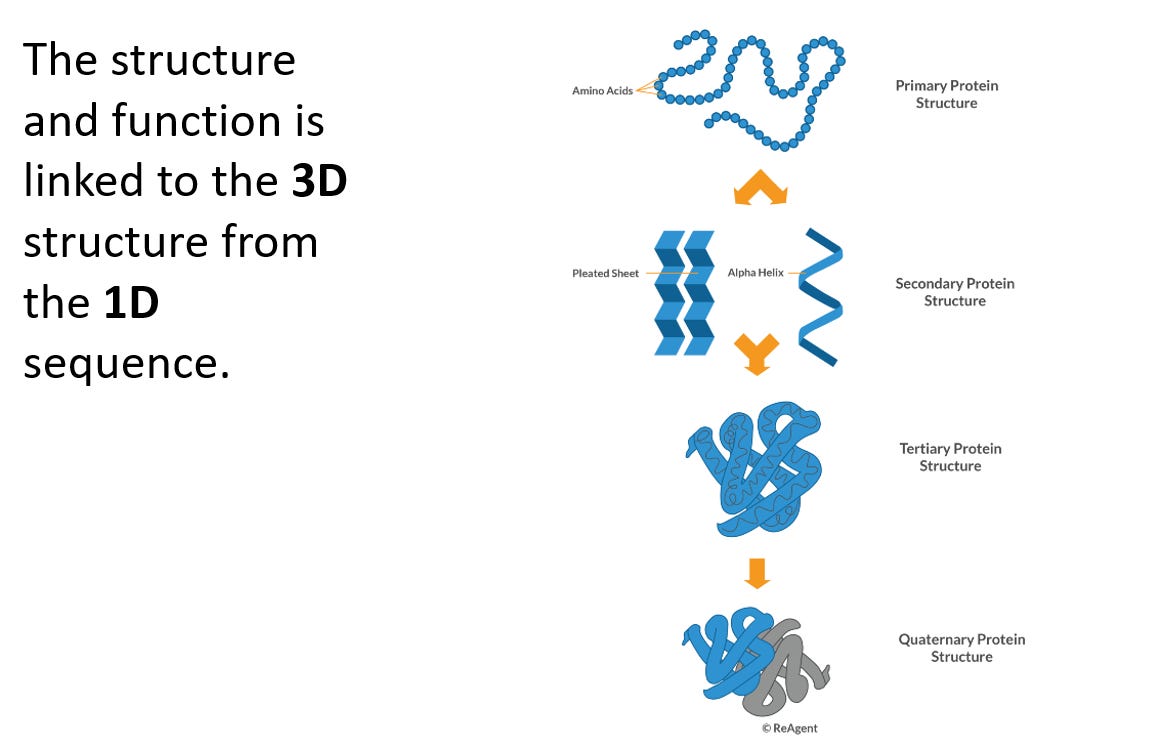
Common model families include ESM, ProtTrans models such as ProtBERT and ProtT5, ProteinBERT, generative models such as ProGen and ProtGPT2, and evolution-aware models such as MSA Transformer. These models differ in architecture and training strategy, but they share the idea that large-scale sequence learning can produce reusable protein representations.
Protein models often feel closer to mechanism than DNA models because the path from sequence to function is more direct. A mutation can change an amino acid, the amino acid change can alter structure, and that structural change can affect binding or activity.
Level 3: hybrid biological models
The third level is hybrid modeling, where the goal is to connect multiple biological representations, or define even new representations for a given problem. This is important because real biology does not live in one data type. DNA, RNA, protein, chromatin, methylation, mutation status, copy number, cell identity, tissue structure, and clinical outcome are different views of the same underlying system.
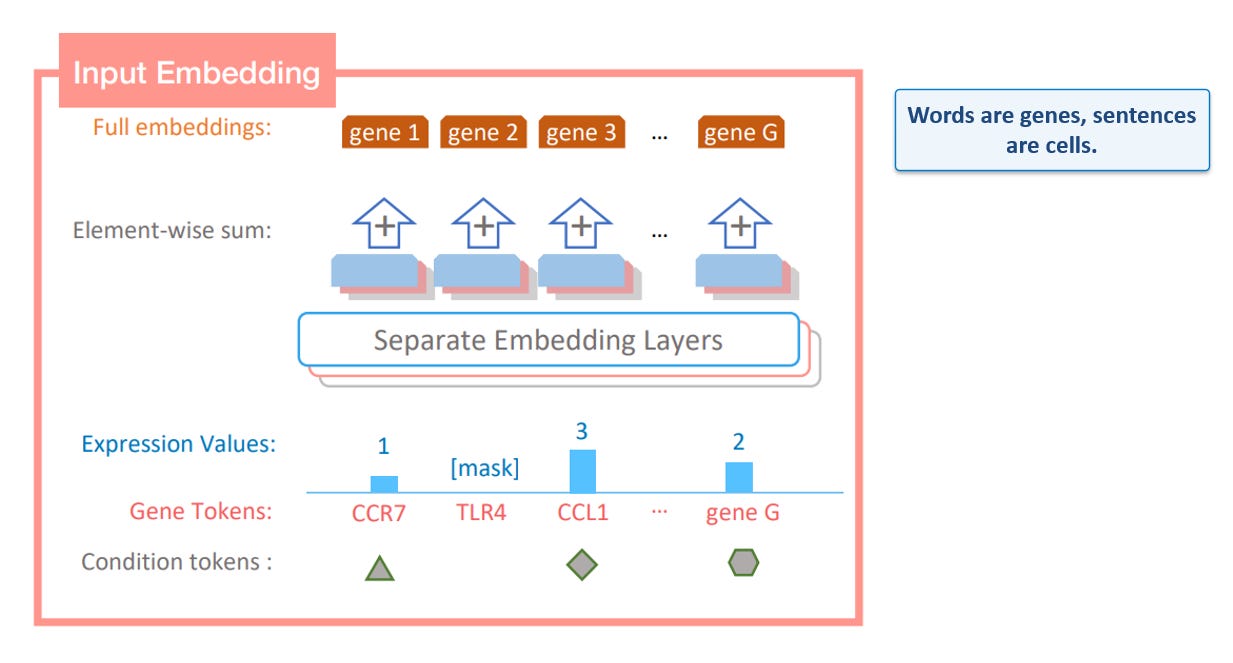
Single-cell foundation models are one example. In single-cell genomics, a common analogy is that genes are words and cells are sentences. The analogy is not perfect, but it captures something important: a cell state is not defined by one marker gene. It is defined by a pattern across many genes.
Models such as scGPT use this kind of idea to learn from single-cell genomics data. They can support cell-type annotation, gene network inference, perturbation prediction, and other tasks where the relationships between genes and cells matter.
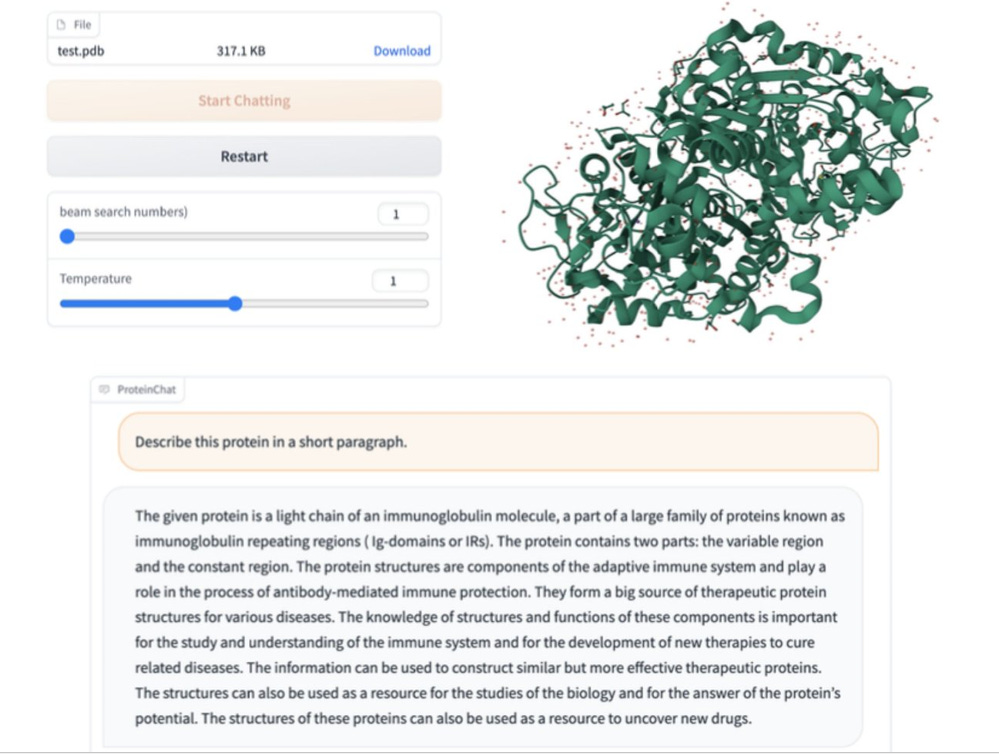
Other hybrid systems connect protein representations with human language. ProteinChat, for example, points toward an interface where protein structure and function can be explored through natural language. This is not just a convenience feature, but it is part of a larger shift where models begin to translate between biological representations and human interpretation.
Level 4: human scientific text
The fourth level is human text. Biology has produced an enormous written record: papers, abstracts, gene descriptions, pathway databases, clinical annotations, methods sections, reviews, and supplementary tables. LLMs are strong at this level because they can search, summarize, compare, and reorganize this information at a scale that is difficult for humans, but also the end results is understandable by us.
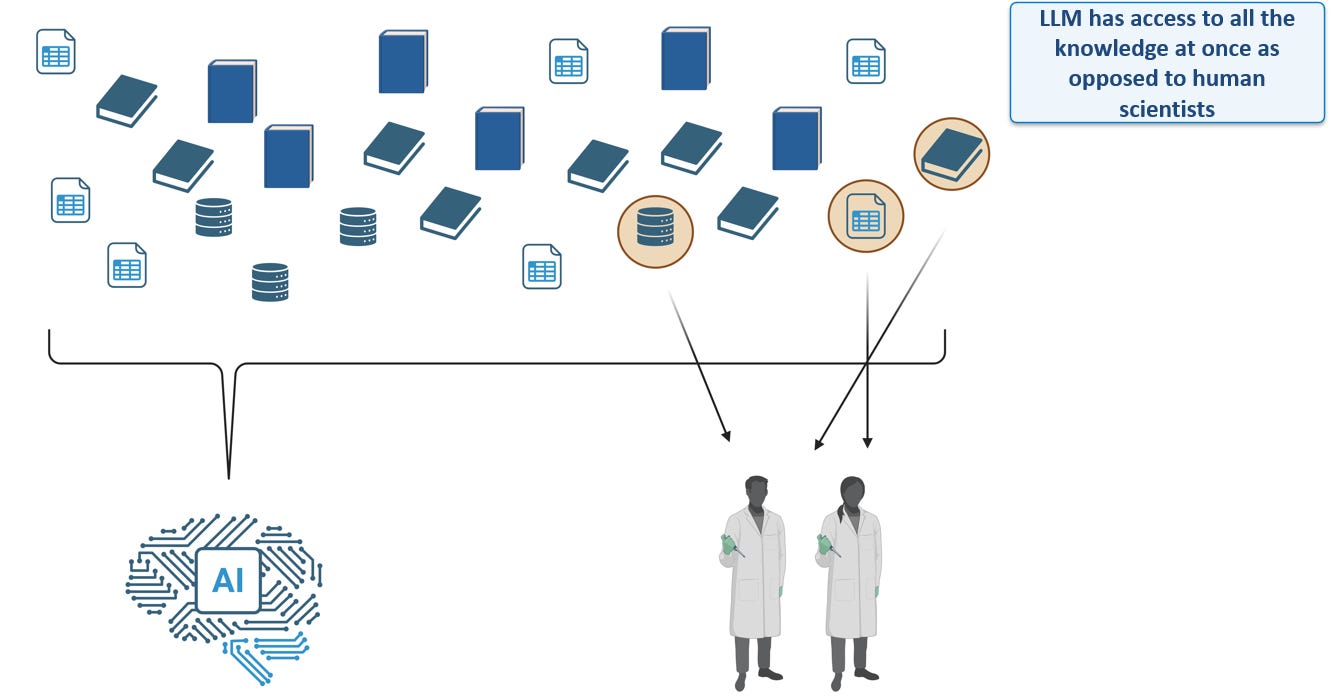
This creates practical applications. LLMs can help with gene prioritization, disease-gene association mining, microbiome-disease relationship discovery, cancer predisposition gene identification, literature screening, and interpretation of pathway results. They can take a long list of genes and produce a structured summary of known functions, possible mechanisms, disease associations, and supporting evidence.
But this level has a major limitation: the literature is not biology itself. It is what humans have already written about biology.
That means LLMs inherit the biases of the scientific record. Some genes and pathways are heavily studied, while others have little literature. Some organisms, diseases, and protein families are overrepresented in training data and databases. Negative results are often missing. Old assumptions can be repeated until they look more certain than they are.
A text-based LLM can therefore produce a convincing explanation that mostly reflects the field’s existing attention patterns.
Level 5: LLMs for scientific data analysis
The fifth level is scientific data analysis itself. Here, the LLM is not only reading a sequence, a protein, a cell profile, or a paper, but it is writing code, choosing analysis methods, generating plots, comparing outputs, calling tools, and producing reports.
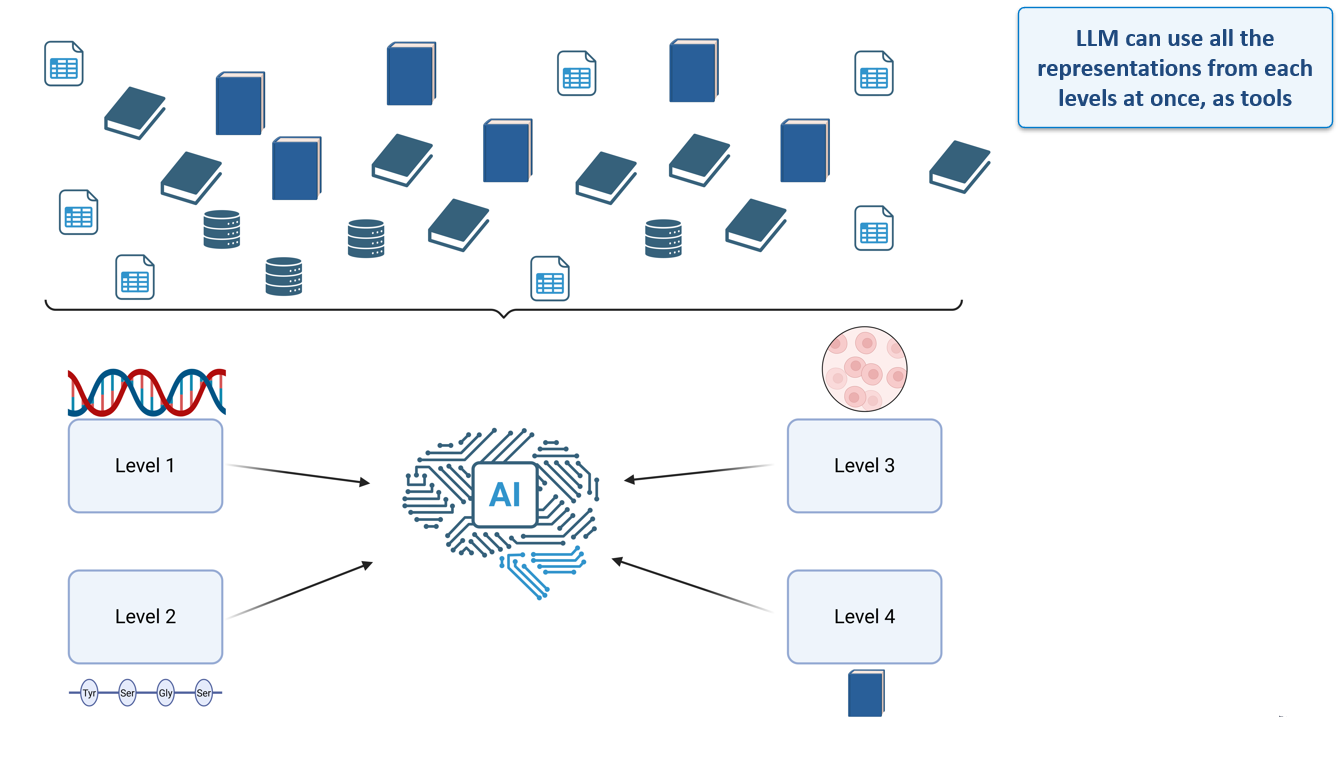
This is probably one of the most practically useful roles for LLMs in biology, because a lot of scientific work involves technical implementation. Data has to be cleaned, normalized, transformed, joined, filtered, visualized, modeled, and checked. An LLM can speed up many of these steps.
An LLM can help implement these steps, but it can also make hidden mistakes. This is why data-analysis agents need constraints. Some parts of the workflow should be flexible, especially during exploration. Other parts should be fixed, tested, and reproducible.
High-throughput LLM screening
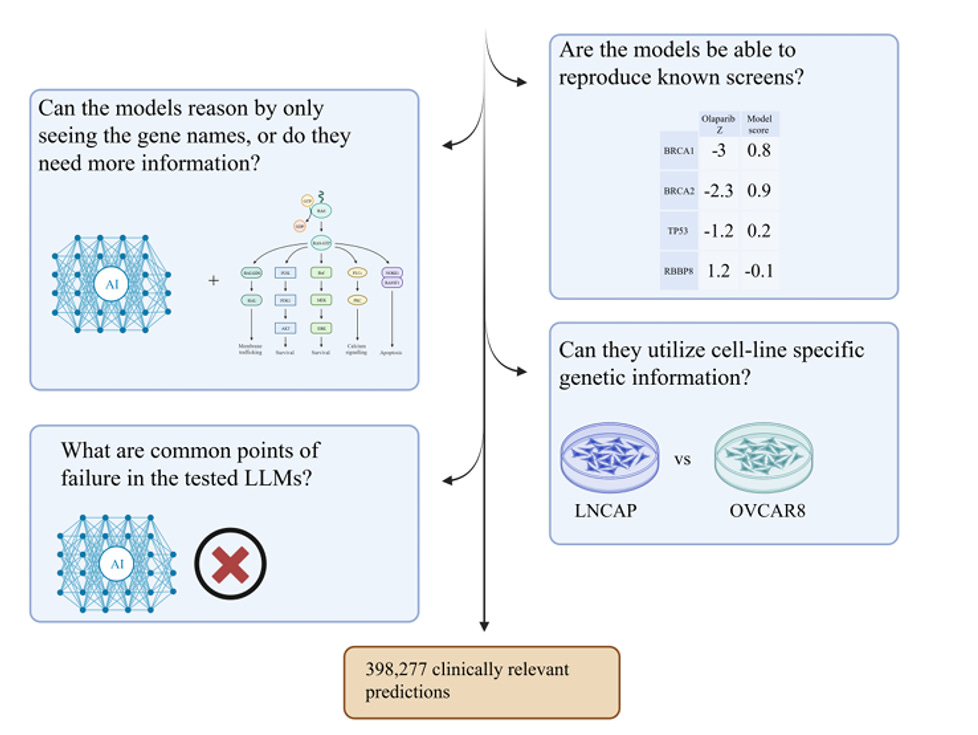
One of the more interesting directions is high-throughput LLM screening. Instead of asking an LLM to interpret one gene, pathway, or result, the system can screen many candidates and rank them according to biological relevance, literature support, novelty, mechanistic plausibility, or disease connection.
This is useful because modern biological datasets often produce too many candidates for manual interpretation. A differential expression analysis, survival screen, perturbation experiment, or model interpretation step may return hundreds or thousands of genes. An LLM can help triage this space by turning raw candidates into a smaller set of hypotheses.
However, this approach is only useful if the screening is grounded and controlled. If the LLM simply writes plausible stories for every candidate, the result is not much better than automated biological storytelling. The useful version has to separate evidence from speculation, known biology from novelty, and literature frequency from actual mechanistic relevance.
This is where LLMs may become better than random guessing or simple non-LLM ranking methods, but still not useful in their raw form. The output has to be connected back to data, validation, and experimental design.
If you are interested in this research, we have actually sent in a manuscript, where you can read about it on more details: https://www.biorxiv.org/content/10.64898/2026.01.28.702211v1.article-metrics
Limitations
Foundation models in biology have several limitations. Interpretability remains difficult. A model can make a correct prediction without giving a clear reason that a scientist can inspect. Bias in training data is also a serious issue, since biological databases such as UniProt and large genomic resources are not neutral samples of life. They reflect what has been measured, curated, funded, and published.
There is also the problem of catastrophic forgetting. A pretrained model may perform well in general, then lose useful capabilities when fine-tuned on a narrower task. Compute cost is another limitation, especially for models that need long genomic context or large-scale multimodal integration.
But the deeper limitation is conceptual. Different models produce different kinds of outputs, and those outputs should not be treated as equivalent. A DNA model may be right about sequence pattern. A protein model may be right about structural similarity. A single-cell model may be right about cell-state relationships. A literature model may be right about what has already been published. A data-analysis agent may be right about a statistical association.
A scientific claim often needs several of these forms of evidence to line up.
Conclusion
Frontier AI models are already routinely used to solve difficult problems in fast-to-validate fields like mathematics. Real breakthroughs in fields like biology is still to be seen.
However, foundation models are already changing how biologists work, but their real value will not come from treating their outputs as discoveries on their own. Instead, their strength lies in helping scientists connect biological languages across DNA, proteins, cells, literature, and data analysis, while keeping each prediction grounded in mechanism and evidence.
The future of AI in biology will therefore depend less on asking models for final answers, and more on using them to generate clearer, testable hypotheses that can be validated experimentally.
If you’d like to read more articles like this:
You do (or don’t) agree with something? Leave a comment:
Disclaimer
The article above was presented at the AI Health Frontiers 2026 conference in Boston (https://luma.com/hlegc5mo), and partly showcases PharosBio-s capabilities (www.pharos.bio). You can try out the scientific discovery data analysis here: https://pharos.bio/join?type=waitlist